Building our way above the floodwater
How this Gulf family rebuilt stronger, after the flood that changed everything
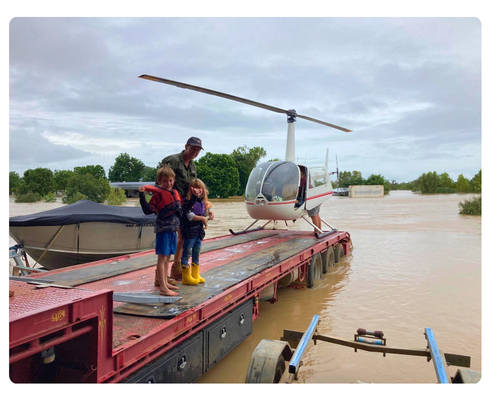
When floodwater swallowed Tirranna Springs Roadhouse in March 2023, Jil Wilson watched her home and a business, built over three years, disappear under water more than two and a half metres deep. The roadhouse she and husband Tim own, sits between Burketown and Doomadgee, deep in the Gulf of Carpentaria, had flooded before. This time was different.
As the water kept rising, Jil and Tim climbed onto a trailer in their yard and were winched to safety by a neighbour's helicopter. Weeks later, when Tim was flown back in to begin the clean-up, he found a home gutted, animals lost and years of belongings destroyed beyond saving.
Evacuating the property, March 2023
For Jil, a former German backpacker turned north Queensland roadhouse owner, that flood could have been the end of the road. Instead, it's the reason her family rebuilt everything three metres higher, and her story carries lessons for every Queensland household and business heading into another wet season.
A life built around two Gulf communities
Jil first came to Australia as a backpacker in 2007, working on cattle stations before returning to Germany to finish her teaching degree. She moved back permanently in 2014, this time with her now husband, Tim, a builder, settling into remote work across north Queensland. The couple were living in Doomadgee when they spotted Tirranna Springs for sale on one of their regular trips to town and bought it in 2018.
“What I love most about the area is the community,” Jil said. “Both the Burketown and Doomadgee communities have gotten very close to our hearts. We're a bit like Switzerland, we don't get involved, but we're a safe haven for everyone from both communities.”
Tirranna Springs runs a roadhouse and accommodation business alongside Tim's building company, and doubles as a working animal farm that hosts community groups, family camps and visits from both towns.
When the wet season turns dangerous
Jil and Tim already knew Tirranna Springs could flood. What they hadn't planned for was how high.
“We got flooded in 2023, and it come very unexpectedly,” Jil said. “We'd been flooded in for weeks prior without any imminent danger, there was just water in the yard. But the house was dry. Then it just kept creeping higher, and the rain was relentless.”
The family moved to another building on the property as the water rose, then to a trailer, where a neighbour's helicopter winched them out. Floodwater eventually reached close to three metres through the property, tearing away 20,000 litre water tanks, fencing, gardens and accommodation buildings that had been built at what was then standard Queensland height, about a metre off the ground.
“All our buildings were your standard Queensland height, off the ground just for pests and to allow air circulation,” Jil said. “We did know this area floods. It's just knowing how high it can come.”
Jil and the children were evacuated to Burketown, sleeping on the floor of the local kindergarten before friends made a house available. Tim stayed behind with his brother and long-term staff to begin the clean-up, a process that took months.
Building back stronger
Faced with rebuilding, Jil and Tim made a decision that has shaped everything since.
“I said to Tim, I don't really know how I can live here knowing this could happen again,” Jil said. “He said, well, we just have to build out of the flood level, don't we. So that's exactly what we did.”
The house and accommodation were raised first, to 3.2 metres, so returning staff had somewhere to stay while the roadhouse itself was rebuilt over the following year. The Doomadgee and Burketown communities stepped in throughout, from family camps held on bare gravel while the lawns recovered, to council rangers helping clear mud and debris from the roadhouse.
“Everyone worked their guts out,” Jil said. “It was a testament to everyone involved.”
Planning a business around a season you can't control
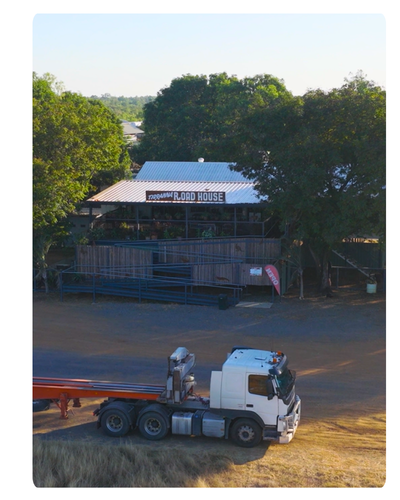
Running a roadhouse and a building business in the Gulf means planning for a wet season that arrives every year but never behaves the same way twice.
“You can make a plan, but that doesn't necessarily mean it will come to fruition,” Jil said. “You have to be smart, and you have to be spontaneous.”
Staff numbers swing from a handful over the wet season to up to 25 during the dry season, and freight only arrives once a fortnight, so stock control and forward planning are constant. Jil's advice to anyone starting a business in a remote part of Queensland is simple: build in the downtime and use the busy months to build a buffer.
“Get used to the wet season,” she said. “You've got to put money aside and make your money in the peak periods.”
Raising resilient kids in the Gulf
Holly, 7, and Hunter, 9, have grown up between the two communities their parents call home, and Jil credits much of their confidence during severe weather to that connection. Family friends in Doomadgee, including a woman the children call Nana Isabel, have taught Holly and Hunter to read the land, from knowing when it's snake season to understanding when floodwaters are building.
“They've never been afraid of the wet season or the dry season,” Jil said. “I don't think they've ever felt lost or scared, or not supported in their needs.”
Getting your own household or business flood ready
Jil's family learned that Queensland's flood risk can change without much warning, and that preparation has to go beyond a good wet season plan.
Know your flood risk before the wet season starts. Local councils, including those across the Gulf, hold flood height and hazard information that can show whether your property sits in a flood-prone area, and how high water has reached in the past.
Take action: Check your flood risk with your local council's disaster dashboard and ask what the highest recorded flood level has been for your area. |
Plan for isolation, not just a storm. Communities like Doomadgee and Burketown can be cut off by road for months at a time. Build your emergency plan around your household and their lives. What family and services you might need to stay in contact with if you need to evacuate. Who you need to look out for, including your animals and your livelihood.
For businesses , a continuity plan matters as much as a household one. Think through staff rosters, how you'll communicate if phone and internet drop out, and how you'll manage supplies if freight is delayed for weeks rather than days.
Take action: Build your household emergency plan, and include contacts, pets and anyone in your household who might need extra help. |
Before the weather comes in, consider what your household actually needs for your situation. What someone needs in cities like Brisbane and the Sunshine Coast is completely different to what is needed in Burketown where an extended period of isolation is part of life. This includes food, water, medication, fuel, etc. No one needs to be out panic buying just before the roads get cut, and that includes prescription medications.
Take action: Next time you are at the shops, grab a few things to add to your Emergency Kit to keep it ready for the next time you loose power or worse. |
Next steps
Jil and Tim's story shows that getting ready for severe weather isn't a one-off job, it's something Queensland households and businesses build on every year.
The Get Ready Queensland checklist is a great place to start.
You can also take these steps to get your own household or business ready this wet season:
Bookmark your local council's disaster dashboard [LC6] so you know what's happening in your area.
Check your insurance covers your home, business and belongings for flood.
Create an emergency contact list and add it to your household or business plan.
Check your emergency kit is stocked for an extended period of isolation, not just a couple of days.
Get Ready Queensland Week 2026 runs from 5 to 11 October, with events happening across the state. Visit the Get Ready Queensland Week webpage to find one near you.
Want more preparation tips for remote and rural properties? Visit your local council's website for flood mapping and disaster information specific to your area.
Every Queenslander, needs to Get Queensland Ready.