How a Gulf freight company keeps remote communities supplied through the wet season
In the Gulf of Carpentaria, freight isn't just a delivery, it's a lifeline. For remote communities separated by vast distances and rivers that can swell overnight, the weekly truck or barge run carries the groceries, medical supplies and everyday essentials that keep life moving. Every wet season, the same challenge returns: rivers rise, roads disappear underwater, and getting supplies becomes a logistical operation involving trucks, barges, fuel runs and no shortage of teamwork.
For Sean, who works across Carpentaria Freight's road and marine operations, one particularly long wet season showed exactly how quickly a routine freight run can turn into a race against rising water. For Sean it meant keeping supplies moving through the Gulf meant adapting to whatever the wet season threw at him.
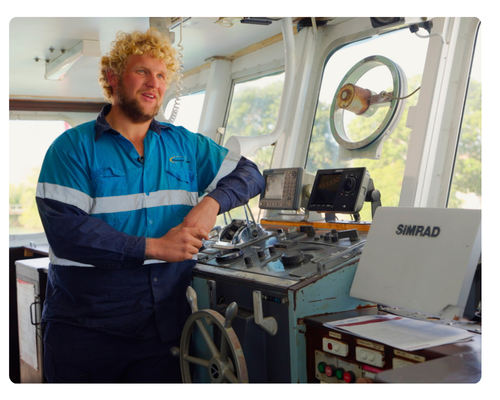
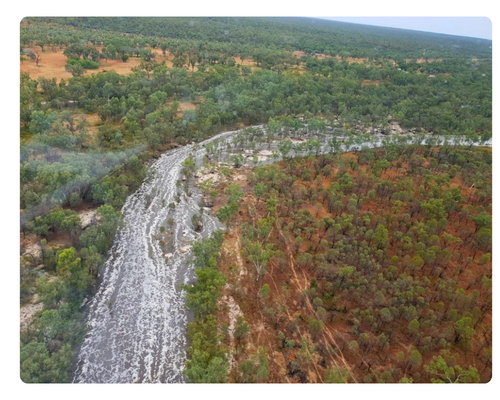
“I remember heading back to Cairns, and I was racing against the water. I remember coming over the Gilbert River, and the water was lapping the bridge, and so I just got across, and then after that, it was no more holidays, really.”
A supply chain built around distance
On an ordinary run, the freight task is straightforward. Carpentaria Freight transports goods from Cairns to Karumba by road, then loads freight onto barges servicing Gulf islands, including Mornington Island. For many Mornington Island residents, that weekly barge carries grocery orders and other essentials from the mainland.
There's nothing standard about moving freight through the Gulf during a major wet, though. “Usually, it's pretty straightforward. There's always challenges, but it's a straightforward operation. We get the freight in Cairns, we bring it to Karumba, we load it on the barge and send it to the islands. But this one was a very big wet season, compared to what we've had recently. It threw a massive spanner in the works.”
The stakes rise fast when refrigerated food is sitting behind a river that won't let a truck through. Sean remembers being held up at Gilbert River for days with freight destined for communities further west. “I had to wait at the Gilbert for, I think it was four or five days after New Year's, on the way back out here with some freight, and you don't really want chiller and freezer waiting around. You need that on the shelves, especially the island. They're only getting one grocery run a week, so you can't have it wait until next week's run.”
When the fuel gauge becomes the deadline
Waiting for floodwater to fall is one thing. Waiting with a truckload of refrigerated freight changes the equation entirely. Carpentaria Freight's refrigerated trailers run their own onboard engine and fuel supply, and Sean says fuel only lasts so long before the load itself is at risk, a timeframe far shorter than the extended isolation periods the Gulf's wet season can bring.
When Sean became stuck at Gilbert River, keeping the freight cold meant finding another way to top up the tank. “We had to drop the trailers, run back into Georgetown with some jerry cans, fuel up there, and bring fuel back for the van. That's 80km backtracking, and yeah, you do have a short window. You can get stuck between one river and another and can't get back out, so you're always challenged.”
As the diesel level falls, the pressure rises. “When the fuel level gets down pretty low, you start sweating a bit. It's not the best thing to run a fridge van dry. A lot of money in there.”
Take action: If your business relies on refrigeration, generators or vehicles that need fuel to keep running, build a buffer into your planning for an extended period of isolation, not just a day or two. Head to the Get Ready Queensland business page to learn about planning. |
If the road stops, find another way
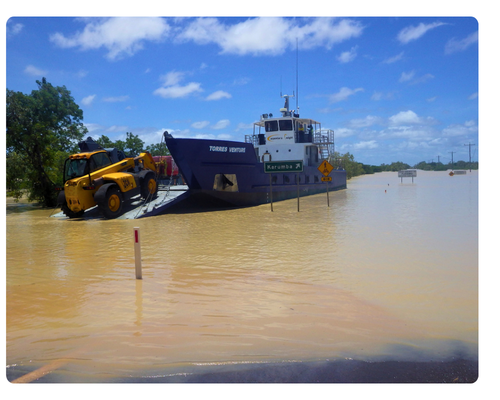
That ability to adapt is fundamental to operating in the Gulf. During significant flooding, freight movements can become multimodal operations involving trucks, forklifts, telehandlers, boats and barges. Sean describes unloading freight from trucks at Critters Camp, loading it onto barges and moving it along the river to Burns Philp in Normanton, where larger vessels can carry it further to Karumba or on towards the islands.
Carpentaria Freight has also invested in equipment built specifically for flood operations. “We've got a 12-metre aluminium barge that we brought over from Mornington Island for this specific job. We don't use it for anything else, but the flood work we do, and that's been a massive help.”
For Sean, adapting to conditions is simply how the family business operates. “We're always very adaptive to our conditions. The old man always taught me, you never really back down from a challenge. That's how the whole business is led, to be honest.”
Local knowledge keeps the network moving
Flood preparedness in the Gulf isn't only about machinery; it's also about information. Before leaving Cairns during the wet season, Sean and his crews check which rivers are already over, which are likely to rise, and what conditions are doing further along the route.
Technology helps. Starlink was brought into the operation so crews could maintain communications and independently check rainfall and river conditions while travelling through areas with limited connectivity. But technology is only one part of the picture. Knowing how to read what a river gauge means on the ground, and what water falling hundreds of kilometres away might mean for a particular crossing, comes from experience, local knowledge and a network of drivers who never stop talking to each other.
“This time of year, everyone's phones never stop. People you haven't heard from will call you up because they know you've come through, and they'll ask what it's doing out there. It's just constant communication with everyone.”
Take action: Before you travel during severe weather season, check current conditions on QldTraffic and sign up for warnings from the Bureau of Meteorology and your local council, the same checks Carpentaria Freight's crews run before every trip. |
People see what needs doing, and they help
Sean's story isn't only about trucks, barges and flooded roads, it's also about people. During the hardest stretches, freight operators worked alongside emergency services, station workers, helicopter pilots and other transport companies to keep supplies moving.
“It always surprises me. Sometimes you might think you're alone out these ways, but the reaction you get from everyone when stuff starts to get hard, it's just unreal. The lads from the station, the helicopter pilots you never see, everyone sort of rocks up and does a massive job of helping out.”
Sometimes the help was practical. Other times it was as simple as someone noticing that crews working through the heat needed looking after. Sean remembers working at the boat ramp in Normanton on a day when the temperature hit around 40 degrees. “Down at the boat ramp, 40 degrees or something, people would come down and give you cold drinks or a sandwich. Just those little things. People care. People appreciate what you're doing.”
Even with all that effort, Sean is the first to admit no one could fully plan for how long that wet season lasted. “A hundred percent, it's fuel. No one had enough fuel. No one was prepared in that way. It went for longer than anyone expected, so who could really plan for that?”
Getting your own business ready for the wet season
Sean's experience holds lessons for any Queensland business that depends on roads, tourism or a single supply run to keep going.
Know your risk. Contact your local council to understand flood, cyclone or storm tide risk to your premises and your supply routes and talk to your team about what that means day to day.
Make a plan. Think through fuel, refrigeration, staff rosters and communication if phone and internet drop out, and how you'll support customers who may be cut off when roads close. A business continuity plan helps you prepare for the risks you can't control and get back to operating as quickly as possible. Business Queensland has a continuity planning guide and a free short course at www.business.qld.gov.au .
Pack a kit. Keep extra fuel, water, spare parts and non-perishable supplies on hand for vehicles, equipment and staff, and know how long your systems, whether that's refrigeration, generators or communications, can run before they need topping up.
Stay connected. Sign up for Bureau of Meteorology warnings and your local council's disaster dashboard, and check QldTraffic before you travel during severe weather season. If you operate in an area with limited mobile coverage, look at satellite options such as Starlink to keep crews in touch with conditions.
Next steps
Sean's experience through that long, wet season shows that getting ready for severe weather means building habits into how a business runs all year round, not reacting once a warning is issued.
Take these steps to get your own business ready this wet season:
Check your business's flood, cyclone and storm tide risk with your local council.
Build a business continuity plan that covers fuel, refrigeration, staff and communication.
Sign up for Bureau of Meteorology warnings and check QldTraffic before you travel.
Talk to your team about what to do if roads close for an extended period.
Get Ready Queensland Week 2026 runs from 5 to 11 October, with events happening across the state. Visit the Get Ready Queensland week page o find one near you.
Want more preparation tips for freight, transport and remote businesses? Visit Business Queensland at for continuity planning tools and support. Because every Queensland business, wherever it operates, deserves to feel ready.